
When Life Feels Heavier Than It Used To: What Depression Really Feels Like

In our fast-paced, high-achievement culture, we often reserve the word "depression" for a total collapse. When we picture depression, we typically think about the person who cannot get out of bed or the one in the midst of a visible crisis. But for many, depression doesn't look like a breakdown. In fact, it might look like a slow, quiet fading.
It looks like answering emails, picking up the kids, and making dinner, all while feeling like you are moving through waist-deep water. This is the reality for countless people who are functioning on the outside but may be struggling on the inside, and many don’t realize that therapy for depression can support these quieter experiences.
When the Word “Depression” Feels Hard to Claim
Many people hesitate to use the word depression. You might be one of them. You may still be going to work, caring for your family, responding to messages, and meeting your normal responsibilities. On the outside, your life looks stable, and it may even be successful.
On the inside, however, something feels fundamentally different. Life feels heavier, flatter, and more effortful than it used to be. You might tell yourself you’re just tired, unmotivated, burned out, or simply “in a funk.” You might minimize what you’re feeling because others seem to have it worse, or because you don’t feel "sad" in the traditional sense.
Some worry that using the word depression feels dramatic or "undeserved." You might think, “I have a good life, I have no right to feel this way.” But depression doesn’t always announce itself with a bang. More often, it settles quietly and gradually. Depression changes how you experience time, how you find motivation, how you connect with others, and eventually, how you see yourself. It is possible to experience high-functioning depression while continuing to meet expectations on the outside. Using the word isn't being dramatic, but it’s about being honest so that you can begin to heal.

Depression Is Beyond Sadness
It is a common misconception that depression is simply "being very sad." While sadness can be a component, depression is actually more of an absence. It is an absence of energy, fulfillment, and connection. When you are depressed, life begins to feel muted. Things that once felt engaging, such as hobbies, conversations, and fulfilling projects, may now feel distant or irrelevant. Even moments that are “supposed” to feel good, like a promotion or a holiday, may fail to "land" emotionally. You go through the motions of joy without actually feeling the spark.
Rather than something being “broken” within you, depression is often the mind and body’s response to long periods of stress, emotional overload, loss, or unmet needs. This is why trauma-informed care focuses on understanding what the mind and body have been responding to, rather than labeling someone as broken. Depression frequently develops when there hasn’t been enough space to slow down, rest, or feel supported. For many people, depression is less about a passing mood and more about a systemic state of being that affects the whole person.
Common Ways Depression Can Show Up

If depression were an animal, it would be a chameleon. It looks different from person to person, and there’s no single way it’s “supposed” to feel. Because it doesn't always look like crying, it’s important to recognize the subtle symptoms:
Emotional Numbness: Feeling "flat" or disconnected, as if you are watching your life through a thick pane of glass.
Anhedonia: The loss of interest in things that once brought joy. You might find yourself wondering why you ever liked your favorite book or sport.
Persistent Fatigue: A type of exhaustion that sleep doesn't fix. It's a "soul-tiredness" that makes even small tasks feel like climbing a mountain.
Cognitive Fog: Difficulty concentrating, remembering names, or making simple decisions (like what to eat for dinner).
Social Withdrawal: Pulling back from friends, not because you’re angry, but because the energy required to interact feels unavailable.
The Inner Critic: A sudden increase in self-criticism, guilt, or a harsh inner dialogue that tells you that you are "lazy" or "failing."
A Sense of Heaviness: The feeling that life has lost its buoyancy and everything is weighted down.
You don’t need to experience all of these for your struggle to be valid. Depression is a spectrum, not a checklist.
How Depression Lives in the Body
We often speak of depression as a mental health issue, but it is also deeply physical. Many people notice changes in their bodies long before they recognize a change in their mood because our nervous systems are intricately tied to our emotions, which is why body-based approaches and nervous system regulation can be an important part of depression treatment. When the nervous system has been under prolonged strain, the body often reflects that stress in quiet but persistent ways. Common physical experiences of depression can include:
Sleep Changes: Sleeping much more than usual as a way to escape, or struggling to stay asleep despite feeling exhausted.
Appetite Shifts: Losing interest in food altogether or using eating as a way to numb or self-soothe.
Physical Pain or Discomfort: Unexplained aches, back pain, headaches, or general bodily discomfort. Emotional pain and physical pain are processed through overlapping pathways in the brain.
Digestive Changes: A “heavy,” tense, or unsettled stomach that rarely feels fully at ease.
A Sense of Heaviness in the Body: Some people notice their arms or legs feel unusually heavy or effortful to move, as though their body is weighed down.
These sensations aren’t imagined, but they’re meaningful signals. Your body is trying to communicate that the current pace of your life is no longer sustainable.
Why Depression Often Goes Unnoticed

If depression is so pervasive, why is it so often missed? Several psychological and cultural barriers keep depression hidden:
1. The Comparison Trap
We often minimize our pain by looking at others. "I shouldn't be depressed; I have a job and a home. There are people in war zones who are doing better than me." Compassion is not a finite resource. Acknowledging your own pain doesn't diminish the suffering of others.
2. Productivity as a Mask
In a society that values "doing" over "being," we often use productivity to hide our emotional depletion. When productivity becomes the primary measure of worth, perfectionism can quietly reinforce depression rather than protect against it.
3. Survival Mode Becomes the Norm
When you live in survival mode for months or years, you lose your baseline for what "normal" feels like. You forget what it's like to wake up feeling refreshed or excited for the day, so you assume your current state is just "getting older" or "part of life."
4. Cultural Stigma
Many of us grew up with messages that equate strength with independence and silence. We are taught that "pulling ourselves up by our bootstraps" is the only way forward. In this framework, depression is seen as a weakness rather than a health condition.

Why Depression "Makes Sense"
One of the most transformative shifts in therapy is moving from asking "What is wrong with me?" to asking "What am I responding to?" When you look at your life through a lens of compassion, depression often starts to make a lot of sense. Depression is frequently a protective mechanism. This might look like a "shutdown" response that occurs when:
You’ve been carrying the weight of others' responsibilities for too long.
You’ve experienced a "micro-loss" (the loss of a dream, a friendship, or a sense of safety) without space to mourn.
Rest has felt "unsafe" or like something you had to "earn."
You’ve had to suppress your true feelings to keep the peace in your environment.
In this light, depression isn't a failure of your character, but an over-exhausted nervous system trying to force you to slow down because it has run out of fuel.
Common Myths That Keep People Stuck
Beliefs can be the biggest barriers to healing. Let's debunk a few:
Myth: "I should be able to think my way out of this."
Reality: Depression is biological and emotional, not just logical. You can't "logic" your way out of a broken leg, and you can't "think" your way out of a neurochemical and nervous system shift.
Myth: "If I start therapy, I'll have to be on medication forever."
Reality: Therapy and medication are two different tools. Some people use both, some use one. The goal is to find what helps you feel like yourself again.
Myth: "Needing help means I’m weak."
Reality: Vulnerability is the ultimate form of strength. It takes immense courage to admit that the "old way" of doing things isn't working anymore.
Depression and the Inner Critical Voice
Depression often comes with a "voice," and it is usually a mean one. It loves to tell you that you’re lazy, that you’re falling behind your peers, or that you’re a burden to your friends. This inner critic is actually a part of the depression itself. It creates a vicious cycle: you feel low energy -> you criticize yourself for it -> the criticism makes you feel worse -> your energy drops even further.
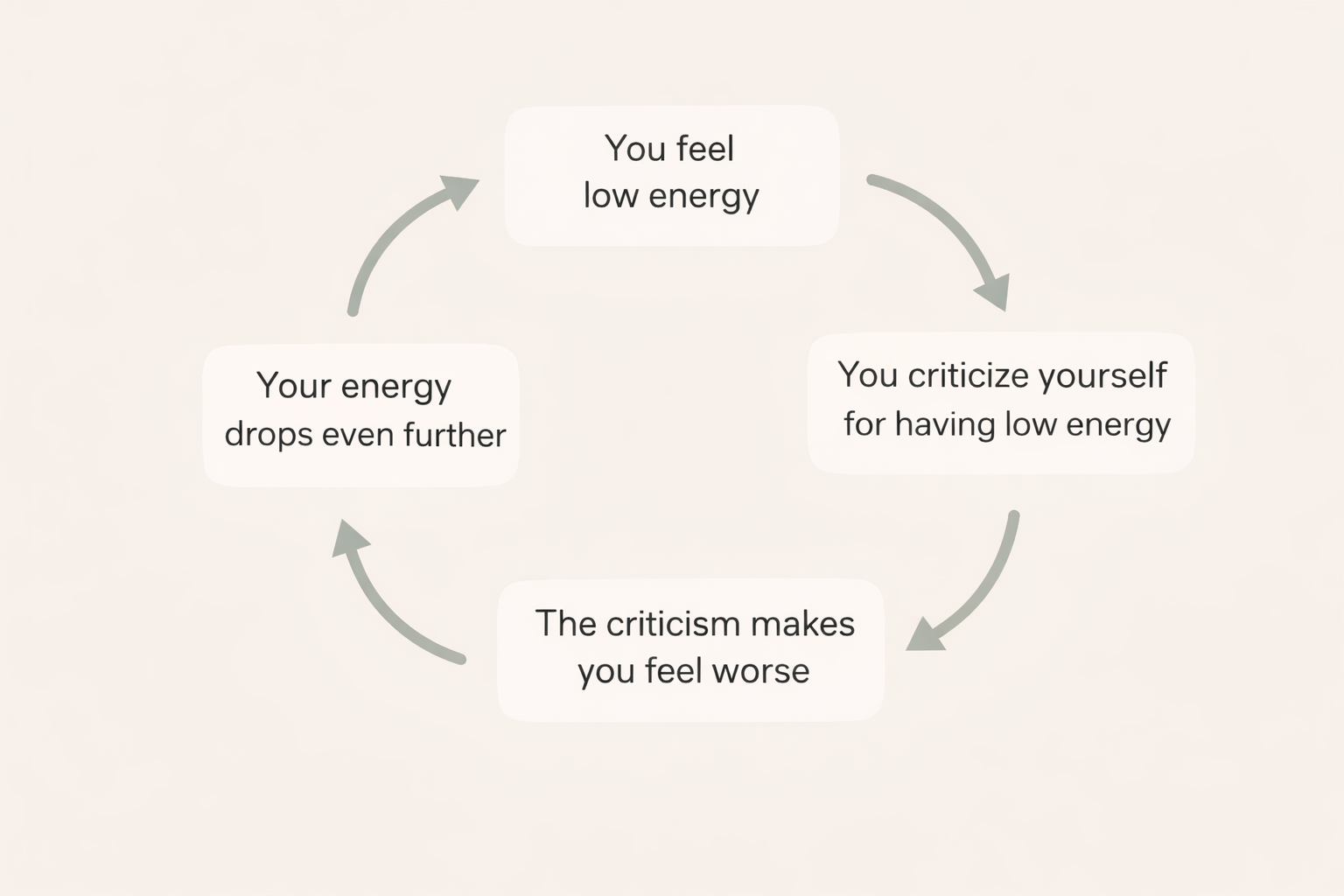
Part of healing is learning to recognize this voice as a symptom, not the truth. In therapy, you can work on externalizing that voice and learning to respond to yourself with the same kindness you would offer a dear friend who was struggling.
How Depression Affects Relationships

Depression doesn't just affect individuals, but it may occur in the space between you and the people you love. You might find yourself:
Being "snappy" or irritable with partners or children.
Feeling "blank" when someone tells you they love you.
Avoiding phone calls because you don't have the energy to "perform" happiness.
Feeling like a burden, which leads to further isolation.
If you are the partner of someone with depression, it’s important to know that their withdrawal isn't a lack of love. If you are the one struggling, remember that your loved ones would likely rather support the "real you" than watch you struggle in silence. Relationship counseling can help partners understand depression without blame and find ways to stay connected through it.
How Therapy Can Help
Therapy for depression isn't about someone telling you to "look on the bright side." It’s a collaborative, safe space to unpack the heaviness you may be experiencing. Here is what that process actually looks like:
Identifying the "Why": We look at the patterns of your life to see what your depression is responding to.
Somatic Awareness: We learn to listen to the body's signals and find ways to regulate your nervous system so you don't feel constantly "shut down."
Safe Reconnection: We slowly experiment with strategies to reconnect to emotions and activities at a pace that doesn't feel overwhelming.
Reducing Shame: By understanding that depression is a physiological and psychological response, we can strip away the layers of shame that keep you stuck.

Progress isn’t linear. It may look like a single clearer moment, or a brief return of interest or connection. These small shifts are meaningful, and they’re often the first signs of healing. Working with one of our therapists means moving at a pace that feels safe, collaborative, and grounded.
You Don’t Have to Hit a Breaking Point
There is a dangerous idea that you have to be "suicidal" or "unable to function" to deserve help. This is not true. You deserve to feel well. You deserve to feel light. You deserve to feel like the protagonist of your own life rather than a passenger. If you feel like you are "surviving" rather than "living," that is enough of a reason to reach out.
A Gentle Closing Thought

If any part of this guide resonated with you, or if you felt a small "yes" in your chest as you read about the heaviness, please know that you are not alone. What you are feeling is a deeply human response to a complex world. Depression is not a sign that you are broken, but it is a sign that you have been carrying too much for too long without enough support. There is a way back to feeling yourself again, and it starts with a single, gentle step toward understanding.
At New Generation Mental Health Counseling, we specialize in working with adults who are navigating these quiet, complex layers of depression. We provide a space where you don't have to "perform" wellness. You can just be. If you’re open to it, we offer brief, no-pressure consultations as a first step toward understanding what kind of support might be helpful for you.