
Negative Self-Talk: Why It Happens and How to Change It
Have you ever caught yourself thinking, “I’m not good enough,” “I always mess things up,” or “Everyone else has their life together except me?” If so, you’re not alone. We often recognize when someone we care about is being overly critical of themselves. We reassure them, remind them of their strengths, and encourage them to be kinder to themselves. Yet when those same harsh thoughts are directed inward, many of us accept them without question.
This internal dialogue is known as negative self-talk. While occasional self-criticism is a normal part of being human, persistent negative self-talk can influence our confidence, relationships, decision-making, and emotional well-being. Over time, these thoughts can begin to feel less like opinions and more like objective facts. The encouraging news is that negative self-talk is a learned pattern and not a permanent personality trait. Like many habits, it can be changed with awareness, practice, and patience.
What Is Negative Self-Talk?
Negative self-talk refers to the ongoing habit of interpreting ourselves, our abilities, or our experiences in an overly critical or pessimistic way.
Some common examples include:
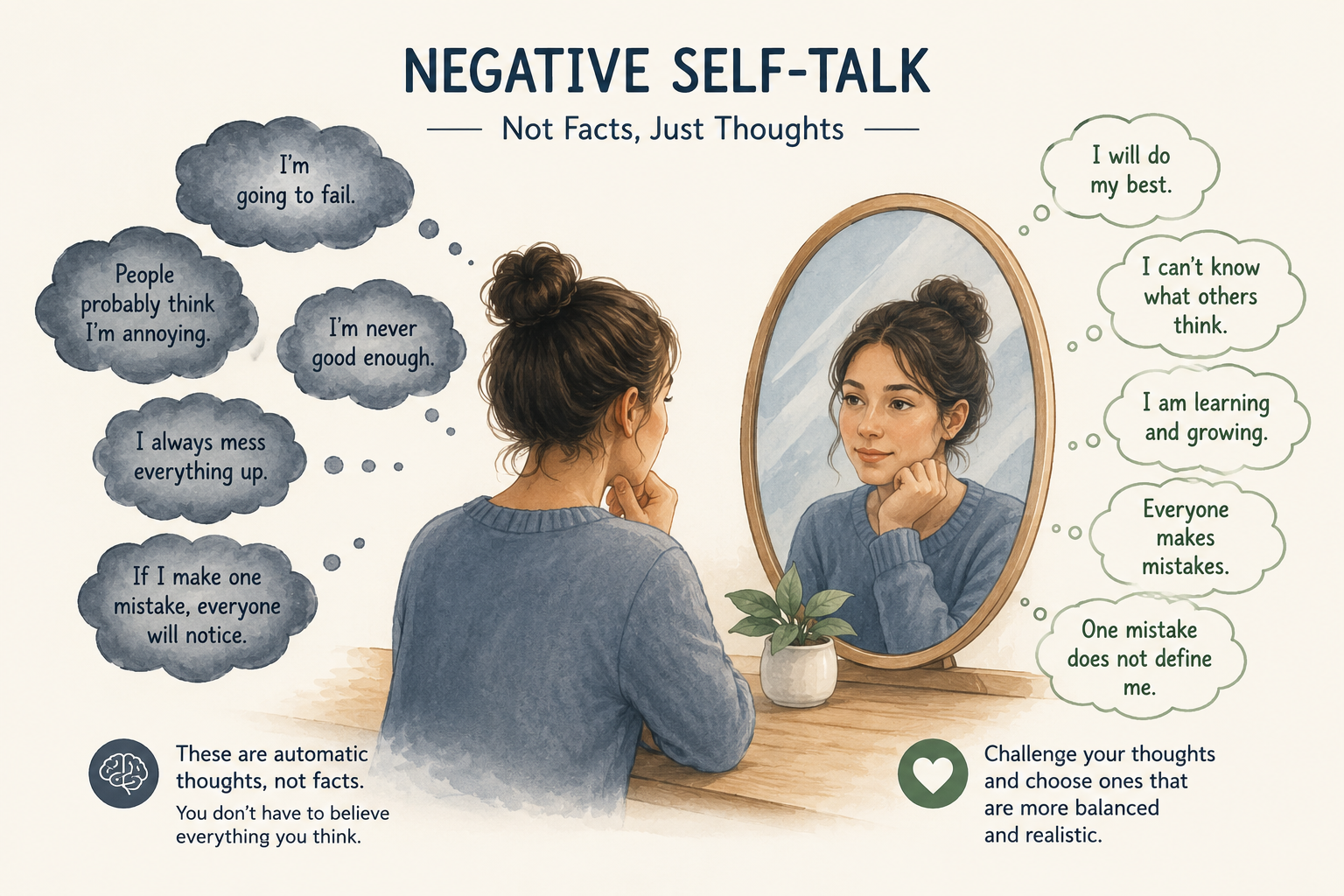
“I’m going to fail.”
“People probably think I’m annoying.”
“I’m never good enough.”
“I always mess everything up.”
“If I make one mistake, everyone will notice.”
Although these thoughts may feel convincing, they are often automatic interpretations rather than objective truths. One thing to remember is that it is not inherently a problem to have these thoughts, as everyone does from time to time. The problem occurs when we consistently believe them without questioning whether they are accurate.
Common Thinking Patterns That Fuel Negative Self-Talk
In cognitive behavioral therapy (CBT), we often discuss cognitive distortions or the habitual thinking patterns that cause us to interpret situations inaccurately or unhelpfully. Everyone experiences these distortions occasionally. The goal is not to eliminate them entirely, but to recognize them before they begin influencing our emotions and behaviors.
All-or-Nothing Thinking
This pattern views situations in extremes. Either everything went perfectly, or it was a complete failure. Examples include:
“I missed one workout, so I’ve ruined my routine.”
“I got one poor grade, so I’m terrible at school.”
In reality, progress is rarely all or nothing. Missing one workout does not erase months of consistency, and one difficult exam says very little about your intelligence or future success.
Learning happens through imperfect attempts and not flawless performance.
Catastrophizing
Catastrophizing occurs when we automatically assume the worst possible outcome. For example:
A mistake at work becomes, “I’m going to lose my job.”
A delayed text message becomes, “They’re upset with me.”
A disagreement with a partner becomes, “Our relationship is falling apart.”
When we catastrophize, our body often reacts as though the feared outcome is already happening. This can increase anxiety, muscle tension, racing thoughts, and avoidance even when there is very little evidence supporting our conclusions.
Disqualifying the Positive
Some people have difficulty accepting compliments, accomplishments, or progress. Instead, they explain them away:
“I just got lucky.”
“Anyone could have done that.”
“It wasn’t that impressive.”
When positive experiences are consistently dismissed, our brains collect evidence only for our perceived shortcomings while ignoring evidence of our strengths. Over time, confidence has little opportunity to grow.
Mind Reading
Mind reading involves assuming we know what others are thinking without any evidence. Examples include:
“They probably think I’m boring.”
“Everyone noticed my mistake.”
“My boss must be disappointed in me.”
The reality is that we cannot accurately know what someone else is thinking unless they tell us. Often, we end up creating stories that generate unnecessary anxiety.
How to Challenge Negative Thoughts
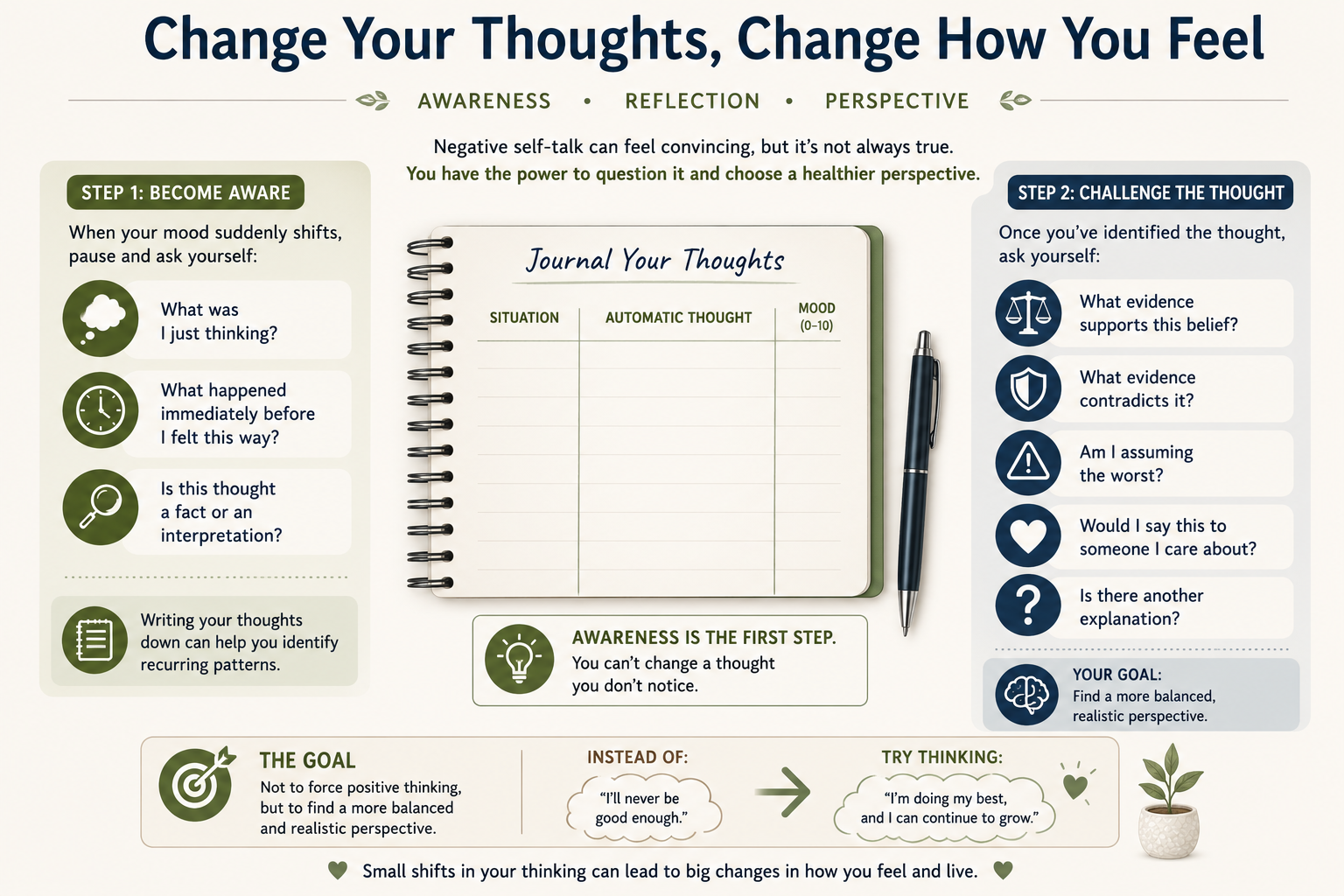
Changing negative self-talk begins with becoming aware of it. The next time you notice your mood suddenly shifts, pause and ask yourself:
What was I just thinking?
What happened immediately before I felt this way?
Is this thought a fact or an interpretation?
Writing these thoughts down can help identify recurring patterns. Once you’ve identified the thought, ask yourself:
What evidence supports this belief?
What evidence contradicts it?
Am I assuming the worst?
Would I say this to someone I care about?
Is there another explanation?
The goal is not to replace every negative thought with unrealistic optimism. Instead, aim for a balanced perspective. For example:
Instead of:
“I missed a deadline. I’m incompetent.”
Try:
“I missed a deadline, and I feel disappointed. One mistake doesn’t define my abilities. What can I learn from this experience?”
Balanced thoughts are generally more believable and more sustainable than forced positive affirmations.
Practice Self-Compassion
When people first hear the phrase self-compassion, they often assume it means lowering their standards or making excuses for their mistakes. It doesn’t. Self-compassion simply means responding to yourself with the same patience, understanding, and kindness you would naturally offer someone you care about.
Imagine your closest friend comes to you after giving an important presentation. They tell you they stumbled over a few words and are convinced everyone thinks they’re incompetent. Most people wouldn’t respond by saying, “You’re right. Everyone probably thinks you’re terrible.” Instead, they’d remind their friend that presentations are stressful, everyone makes mistakes, and one difficult moment doesn’t erase years of hard work or ability. Yet when we make the exact same mistake, our internal dialogue often sounds very different. We criticize ourselves in ways we would never criticize another person. One of the simplest exercises I encourage clients to try is asking themselves:
“If someone I loved were experiencing this exact situation, what would I say to them?”
Often, the answer is surprisingly compassionate, balanced, and realistic. The challenge isn’t learning how to be kind, but to direct that same kindness toward ourselves.
Stop Comparing Your Life to Everyone Else’s
Comparison has always existed, but social media has made it nearly impossible to avoid. Within a few minutes of scrolling, you might see someone’s promotion, engagement, dream vacation, new home, fitness transformation, or business success. Without realizing it, your brain begins comparing your everyday reality to everyone else’s carefully selected highlight reel. What we rarely see are the parts of life that don’t make it onto social media. We don’t see the arguments behind the smiling couple’s vacation photos. We don’t see the financial stress behind the new house. We don’t see the setbacks, insecurities, disappointments, or moments of self-doubt that every person experiences. The more we compare ourselves to curated snapshots of other people’s lives, the easier it becomes to believe we’re somehow falling behind. Instead of asking yourself,
“Why am I not where they are?”
try asking,
“Am I making progress compared to where I was six months ago?”
That question shifts your focus away from someone else’s timeline and back toward your own growth. Everyone’s path looks different, and success doesn’t happen on the same schedule for everyone.
Building Healthier Mental Habits
Changing years of negative self-talk doesn’t happen overnight. Many people become frustrated because they notice themselves slipping back into old thinking patterns and assume they aren’t making progress. In reality, change rarely happens in a straight line. Think about learning any new skill. Whether it’s exercising, learning a language, or playing an instrument, improvement comes through repetition rather than perfection. Building healthier thinking patterns works much the same way. Small, consistent habits practiced every day often have a greater impact than trying to completely change your mindset all at once.
Some habits that many people find helpful include:
Keeping a journal of small accomplishments and moments of gratitude so your mind learns to notice successes instead of only mistakes.
Practicing mindfulness to observe thoughts without immediately accepting them as facts.
Celebrating effort and progress rather than waiting for perfection before acknowledging yourself.
Spending time with supportive people who encourage growth rather than reinforce self-criticism.
Challenging just one negative thought each day with balanced evidence.
None of these strategies are meant to eliminate negative thoughts entirely. Instead, they gradually teach your brain that your inner critic isn’t always the most reliable narrator. Over time, those small shifts begin to accumulate. What once felt automatic starts becoming something you notice, question, and eventually respond to differently.
When to Consider Therapy
Everyone experiences moments of self-doubt. Feeling insecure after making a mistake or worrying about what others think from time to time is a normal part of being human. However, if negative self-talk has become so frequent that it affects your confidence, relationships, work, school, or daily life, it may be time to seek additional support.
Therapy isn’t about forcing yourself to think positively all the time. Instead, it’s about understanding where these patterns came from, learning why they continue to persist, and developing healthier, more balanced ways of responding to yourself. Approaches such as CBT can help individuals recognize unhelpful thinking patterns and replace them with more realistic, balanced perspectives. If your negative self-talk is connected to anxiety, depression, low self-esteem, or perfectionism, addressing those underlying concerns can also help quiet your inner critic over time. Many people discover that as they begin changing the way they speak to themselves, they also become more willing to take healthy risks, pursue meaningful goals, and approach challenges with greater confidence. Their inner critic doesn’t disappear completely, but it becomes much quieter and much less convincing.
If you’re interested in learning more about how therapy can help, explore our Individual Counseling Services or contact us to schedule an appointment.
Final Thoughts
The conversations we have with ourselves often become the lens through which we experience the world. If that inner voice is constantly telling us we’re not good enough, we’ll begin to approach opportunities, relationships, and challenges as though those thoughts are true. Over time, our lives can become smaller because we’ve started believing the stories our inner critic tells us. The positive news is that thoughts are not facts.
Negative self-talk is a learned pattern, which means it can also be changed. The process begins by noticing your thoughts, questioning whether they’re accurate, and responding with greater balance and self-compassion. If you’d like to continue learning practical strategies, you may also find our articles on self-esteem or managing anxiety helpful.
You don’t have to silence your inner critic overnight. You simply have to become curious enough to question it. Progress isn’t about becoming perfectly positive. It’s about gradually replacing automatic criticism with greater understanding, flexibility, and kindness. If negative self-talk has been holding you back, remember that you don’t have to work through it alone. With the right support and evidence-based tools, it’s possible to build a healthier relationship with yourself and move toward a more confident, fulfilling life.